F-Rated
Our programme of films featuring the work of female directors has coincided with the development of the F-rating, a new system designed to flag up the significant involvement of women in film, on either side of the camera.
The F-Rating Manifesto
The stories we see on screen influence our lives. We want to hear stories from everyone, not just from one section of society.
We want diversity in filmmaking, both on and off screen.
The F-rating was founded by Holly Tarquini at Bath Film Festival 2014 where we wanted to highlight films which feature prominent women both behind the camera and in front of it.
Every film which ticks yes to the one of the following questions receives the F-rating of approval:
- Does it have a female director?
- Is it written by a woman?
- Is/are there complex female characters on screen who exist in their own right (not simply there to support to the male lead)?
The F stands for feminist.
Feminism is: "The belief that men and women should have equal rights and opportunities." We believe that feminism benefits everyone.
Featuring

"From Switzerland, this strikingly involving drama traces a single shift in the life of an overworked nurse, highlighting the job while pointedly commenting on the global shortage of hospital nurses. And in Leonie Benesch's wonderfully transparent performance, details emerge that are strongly resonant for any audience. Writer-director Petra Volpe uses expert camerawork, smooth editing and a propulsive pace to hold the interest through both loud and quiet moments" - Rich Cline, Shadows on the Wall.
We join Floria as she arrives for her afternoon shift to find she is understaffed, with only one nurse and a student to help her. Constantly on the move from one patient to another, from one crisis to the next, the camera (and us) follow her all the way, involving us in her stress and the odd short moments of calm. Leonie Benesch (whose last two films were Oscar nominated) gets much credit for this for her "unnervingly nuanced performance" (Rich Cline again) as Floria, aided by the time she spent learning with nurses on a ward.
"Viewers will be as relieved as Floria when the night shift arrives; but the cycle continues and 'Late Shift' pays tribute to those who somehow make it work. End credits point out how endangered Floria's profession is, making this not just a normal hospital drama but a global cry for help" - Fionnuala Halligan, ScreenDaily.
The English title is certainly to the point here, but the original title means 'Heroine'; amen to that.

Kira has gone to Skye to help her get over an ex-boyfriend. Ian is there to see his friends and his ailing parents. They see each other across a crowed pub and the rest is obvious... except it isn't. They have a great night larking about and swapping problems, but the next day they return to their homes and their lives.
Aylin Tezel wrote, directed and starred here, and she has come up with "an antidote to Hollywood-style romcoms...Sensitive, fearlessly honest and forgiving, it sees two people make a connection amid the ongoing chaos of their lives" - Emma Simmonds, The List.
Unbeknownst to either Kira or Ian, they both live in London. Will they or won't they ever meet again..?
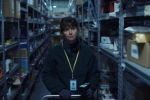
From the producers of 'I, Daniel Blake', their latest social realist story takes us into the world of warehouses, specifically into the world of a Portuguese immigrant in a Scottish warehouse. "The transient space of Scotland's gig economy provides the backdrop for Laura Carreira's accomplished debut feature. By tackling big themes of isolation and the gig economy in an intimate way, she submerges us within them rather than simply showing them to us. The enormous warehouse where Portuguese migrant Aurora (Joana Santos) works is not a destination job for her or most who work there. It's just a place that pays the bills until something better comes along. And better doesn't mean a lot - for example, the friend who car-shares with her dreams of a job where she can sit down" - Amber Wilkinson, Eye for Film.
Aurora is a 'picker', pushing a trolley through the warehouse finding items chosen online by people she will never meet, keeping to a pace set by the machine in her hand. She is paid just enough to live on - when her mobile phone need repairing, this is a disaster as she is forced to go without other essentials.
The isolation in her job is mirrored in her homelife; she has one room in a house-share with others doing similar jobs on different shifts. "There is no pretending 'On Falling' is not a hard, grim watch. But the completeness of its construction remains a marvel throughout. And Santos deserves endless praise for communicating the despairing human eager to break out from the passive drone society wants her to be. An astonishing, unsettling fable of hidden miseries" - Donald Clarke, The Irish Times.
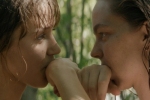
Shy, introverted,16 year-old Lucija joins a Catholic choir where she is befriended by Ana-Marija, "a confident, popular senior who, like Lucija, sings Alto. One of several new girls in the choir, Lucija finds herself standing between Ana-Marija and her friend Klara and is caught up in the slipstream of their racy gossip and scandalous confidences" - Wendy Ide, ScreenDaily.
Lucija's over-protected life (she has not even been allowed to wear lipstick) is faced by the challenge of growing up like everyone, especially the sexual awakening she is feeling. Director Urska Djukic's "coming of age drama is heady with intertwined sensual and religious symbolism; the first rate score and sound design teases out the tangled, conflicting impulses towards Catholic devotion and erotic abandon" - Wendy Ide again.
That said, do not expect a lurid film; the director follows both Lucija's naivety and Ana-Marija's more worldly ways, "each zigzagging along that fine line between immature posturing and actual, exhilarating self-realization, evoking that transitional stage through which girls like them can often seem at least three ages at once. The writing fizzes with the giddy conversational rhythms and savage banter of the generation under scrutiny, but occasionally surprises with an earnest, pensive digression: The film takes seriously, even philosophically, Lucia's struggle to reconcile her emerging libido with a Catholic faith she's more or less taken as given until now" - Guy Lodge, Variety .
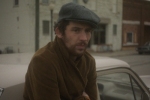
If I tell you this is the story of an art-heist, you might start expecting 'Oceans Twelve' or something, but if I tell you the title is definitely ironic you will be closer to understanding the gist; Josh O'Connor, wonderfully scruffy here, plays James, an art-school dropout who has this great idea to steal some paintings from a local museum in Massachusetts. What could be easier? Well…
If he'd thought about how to do it, if he had reliable fellow thieves, if he'd thought about how he would sell them… excuse the pun, but you get the picture?
Director Kelly Reichardt is more interested in the people, more interested in reality than action. "The very fact of its ostentatiously unadorned reality makes the extraordinary events real and startling, shot, as always with Reichardt, with an earth-tones colour palette in a cold, clear daylight in her unflavoured, unaccented style. We are talking about robbery with guns pointed at innocent people and security guards roughed up, with no dramatic music on the soundtrack (quite as it would be in real life). Reichardt has unerringly located the unglamour in the heist" - Peter Bradshaw, Guardian.
In parts this is almost a comedy - certainly very funny at times - but what the director brings us is a portrait of an everyday-man who thinks he can break out of his dull life, without thinking it through.

Explore KFC
Links
Revisit 2012 Festival

13th Keswick Film Festival
Unlucky for some but not KFF as some of our biggest audiences came to see John Hurt and much much more...
Revisit 2013 Festival

14th Keswick Film Festival
We welcomed John Hurt back as our patron, enjoyed lots of films and much more...
KFF On The Web

Vimeo